Explained
Combat Robot Pre-Match Inspection: Weight, Isolation, Locks and Failsafes
A ruleset-scoped walkthrough of what TRBL checks and how the Impact Robotics League prepares a robot for contained functional testing.
A combat robot can function correctly and still be barred from a match because entry depends on the organizer’s class limits, safety rules and test procedure. The requirements below are scoped to the supplied TRBL material, including its rulebook revision of 14 September 2026, and the documented Impact Robotics League procedure. They should not be treated as universal rules.
Under the documented TRBL requirements, a robot must be within its allowed weight, have accessible power isolation and a secure weapon lock, and cut power to drive and weapon systems within 1 second of losing the radio link.
Confirm eligibility before inspection
TRBL requires the robot to comply with its class weight limit, meet every safety requirement, have prior approval for restricted systems, avoid banned features, and demonstrate controlled movement with an active weapon. The English summary is not the binding text.
Pass the weigh-in
TRBL weighs every robot before each match. A robot more than 2.5 oz (about 70.9 g) over its class limit cannot pass inspection. The team may make a correction and weigh it again during the same session, but a second overweight result withdraws the robot from that match and gives the opponent the win. A team claiming a weight bonus must declare it before the tournament and obtain Organising Committee approval for the design before registration.
Present the robot in a safe condition
The Impact Robotics League does not permit a robot to be powered outside a closed arena or compliant test box, including in the pits. Its rules require batteries to be installed only immediately before entry into one of those enclosures and removed immediately after a match or test. LiPo and LiHV batteries must be charged and stored in a suitable safe bag or container in designated charging areas, with charging attended.
Show that power can be isolated quickly
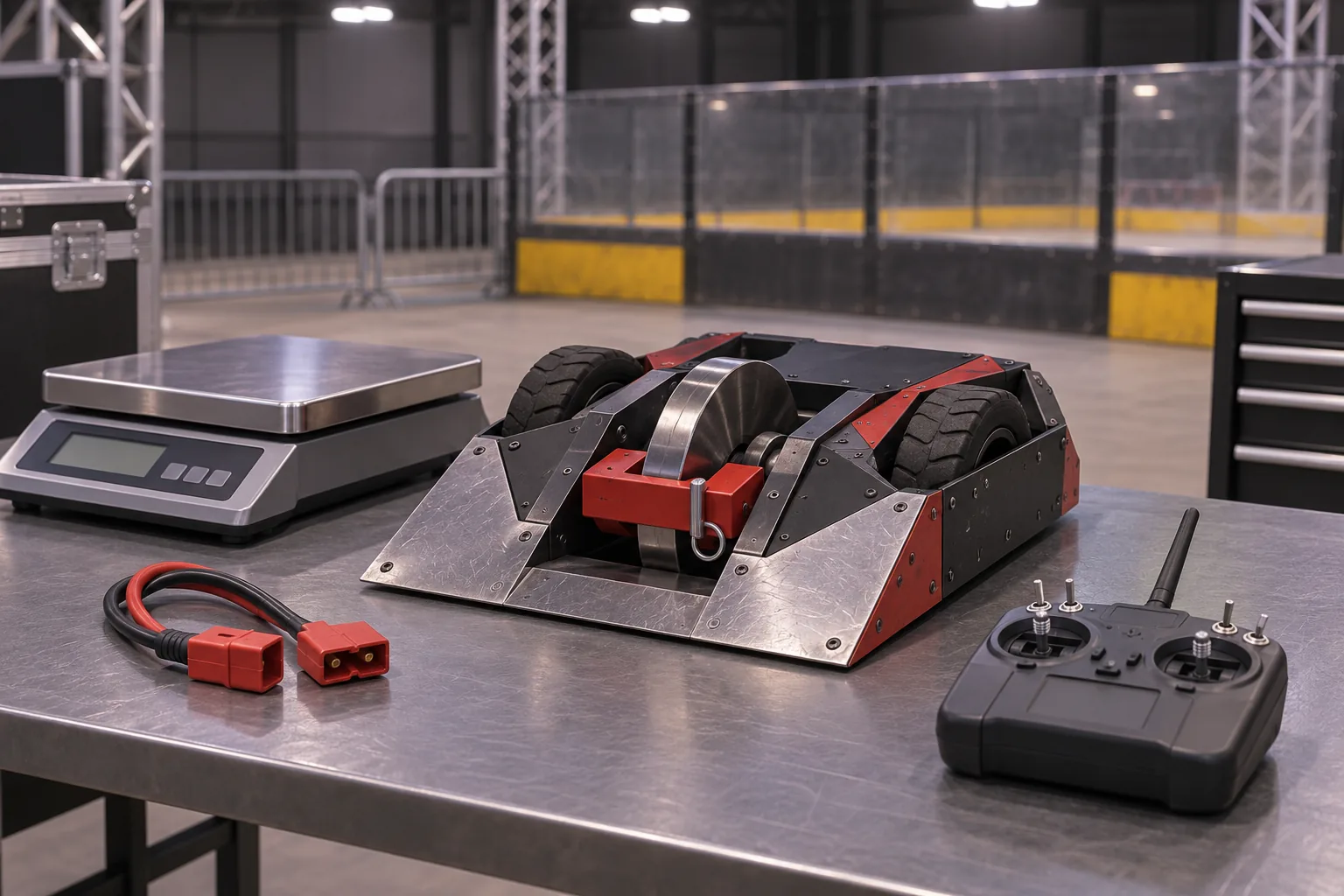
TRBL requires a master switch or removable link that cuts power to every drive and weapon system. It must be reachable without dismantling the robot, operable with one hand, and identified by a sticker on the robot. A 3 lb robot may use its battery connector as the removable link. For 12 and 30 lb robots, the cited requirements add adequate strain relief to the link wiring and accessibility while the robot is in its main fighting orientation. The removable part cannot be secured with a cable tie, although a small amount of tape is allowed.
Fit a weapon lock that physically prevents motion
TRBL calls for a robust lock on every weapon system. Rotating parts must be restrained in every direction, and the device must remain fitted during handling and storage even if the robot falls. Accepted designs can be pulled free quickly in one motion, opened remotely with a button or extension lever, or allow the operator to move a hand quickly out of the weapon path after opening. A latch that requires a finger to remain beneath a rotating weapon is not accepted.
The lock must carry a durable label measuring at least 2.54 × 10.16 cm, with wording such as “Weapon Lock” or “Remove Before Fight.” TRBL permits removal only immediately before a match, during the inspection photo stage, at weigh-in or when an official directs it. Impact similarly requires active weapons to have a conspicuous, labeled and securely attached lock that can physically prevent movement whenever the robot is outside a closed arena or test box.
Prove the radio failsafe
A failsafe is the response programmed for loss of the control signal. At TRBL technical inspection, the transmitter is switched off to reproduce that failure. The failsafe must cut power to both drive and weapon systems; a robot that fails the inspection cannot fight. Each robot, including every part of a multibot, needs its own receiver.
That 1-second test measures removal of power, not the time required for a spinning weapon to coast to a complete stop. The cited TRBL guidance says this spin-down period is measured separately and declared during inspection. The guidance also says a receiver set to hold its last command can cause the robot to continue carrying out that command after the transmitter is switched off.
Follow the event’s contained test sequence
Impact begins its functional safety test with the unpowered robot inside a secure test box and all safety devices fitted. The transmitter is then turned on, placed on a stable surface and left with its controls neutral. Guards or covers may be removed as needed, but the weapon lock stays engaged; the area must be clear and the handler must not touch moving parts. Impact defines a compliant test box as an enclosure with 1/4-inch polycarbonate or equivalent wood walls that remains closed whenever the robot is powered.
The supplied Impact excerpt ends at this preparation stage and does not establish the subsequent powered-test actions or an Impact timing threshold. Impact Robotics League says its rules can change and directs competitors with a borderline design to ask the event host before competition day.
Under the documented TRBL checks, passing requires compliance with the class weight limit and the specified power-isolation, weapon-lock and radio-failsafe requirements. Impact Robotics League begins its functional safety test with the unpowered robot inside a secure test box and all safety devices fitted. Its rules state that this sequence is used at inspection and approved test-box sessions.