Explained
How ARC’s Gameplay Guide Describes a Humanoid Robot Match
ARC’s gameplay description explains pilot-driven motion mirroring, size-bracketed opponents and sensor-detected hits.
In ARC’s gameplay description, a pilot drives a robot that mirrors the pilot’s tracked whole-body movement; robots compete within size brackets, and embedded armour sensors detect valid hits in the head, chest and abdomen zones.
Identify the competitor
The gameplay description treats the pilot and avatar as one competitor, and the pilot’s name appears on the card. A VR rig or full-body motion-capture system tracks the pilot so that the robot mirrors the pilot’s whole body. Both face the same direction, aligning the pilot’s view and movement with the avatar’s actions. This establishes pilot-driven motion mirroring but does not explain any lower-level control or autonomy.
Check the avatar’s class
Opponents compete in brackets intended to place platforms of similar scale together. The same pilot can drive a small, mid-sized or full-sized robot; only the avatar’s size changes.
Read the two-part arena
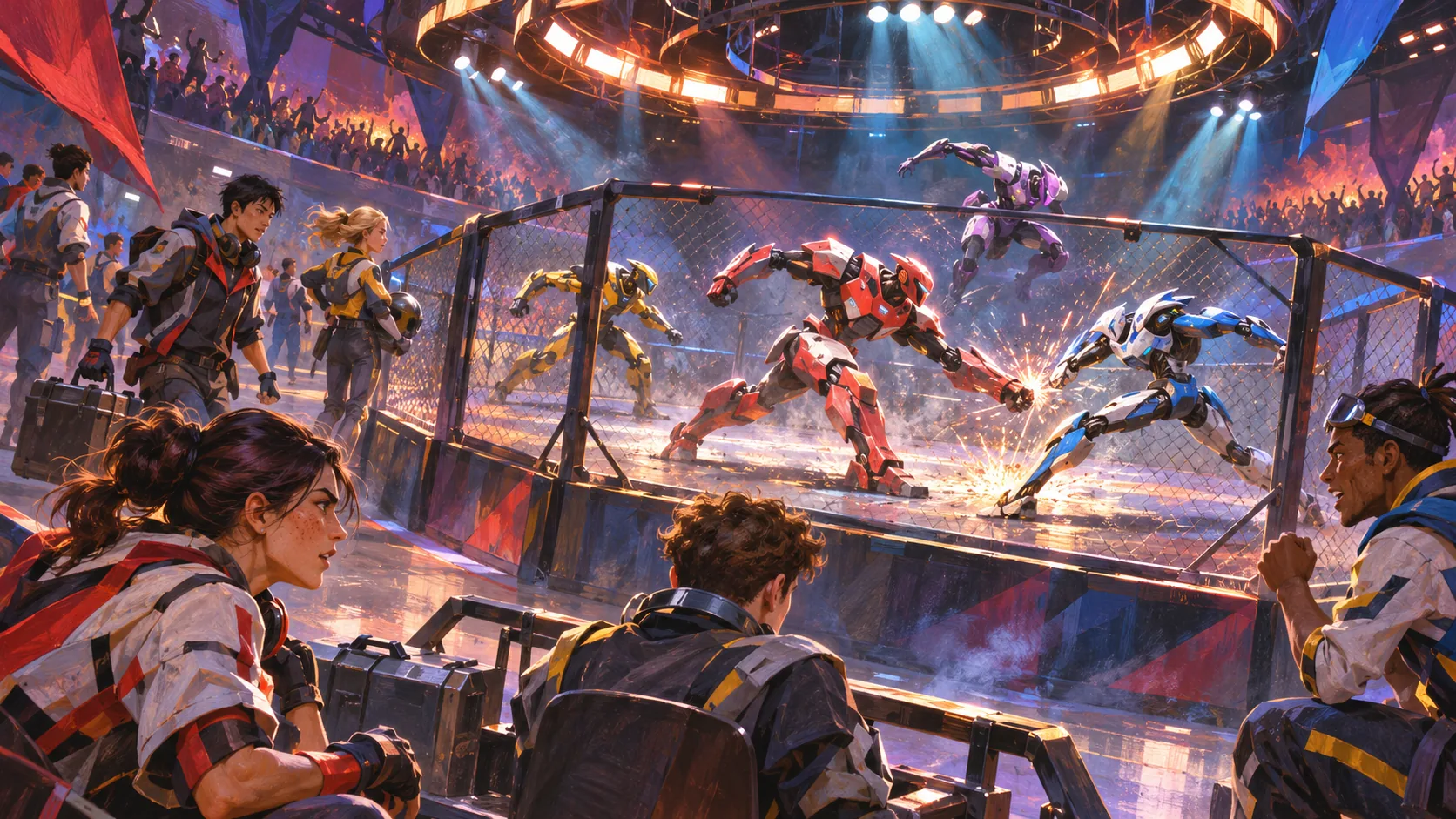
The concentric ring separates the participants physically: avatars occupy the fenced centre, while pilots move in the outer ring. Because pilot and robot face the same way, their movements are presented as one coordinated action despite taking place in separate spaces.
Follow the scoring zones
Custom armour contains embedded sensors that detect valid hits and calculate scoring across three target areas. A direct hit to the head’s cranial sensor array carries a 2× critical-damage multiplier. Chest and abdomen impacts each register standard damage at 1×. To follow an exchange, viewers can first identify the pilot and avatar class, then watch which of these sensor-equipped zones receives the strike and apply the documented multiplier.