Explained
Inside HoloBoxing’s Seven-Minute Claim: Policy Training, Not a Physical Fight
The reported duration measures a limited policy-training stage built on existing motor control, while the accompanying bout images come entirely from simulation.
HoloBoxing’s “seven-minute” claim covers about seven minutes of additional training above a pretrained, frozen whole-body controller, and the cited evidence demonstrates simulated rather than physical robot boxing. The authors count target-representation fitting and a single-GPU task-training run. They exclude controller and training-opponent pretraining, data preparation, evaluation, and search, so the figure does not describe learning whole-body boxing from scratch.
The method keeps the existing controller responsible for joint-level movement. A compact planner requests future body-point targets through a learned decoder, while measured-state imitation initializes that planner before reinforcement learning refines its interaction behavior. This concentrates the new learning in a higher-level policy rather than rebuilding the underlying motor controller.
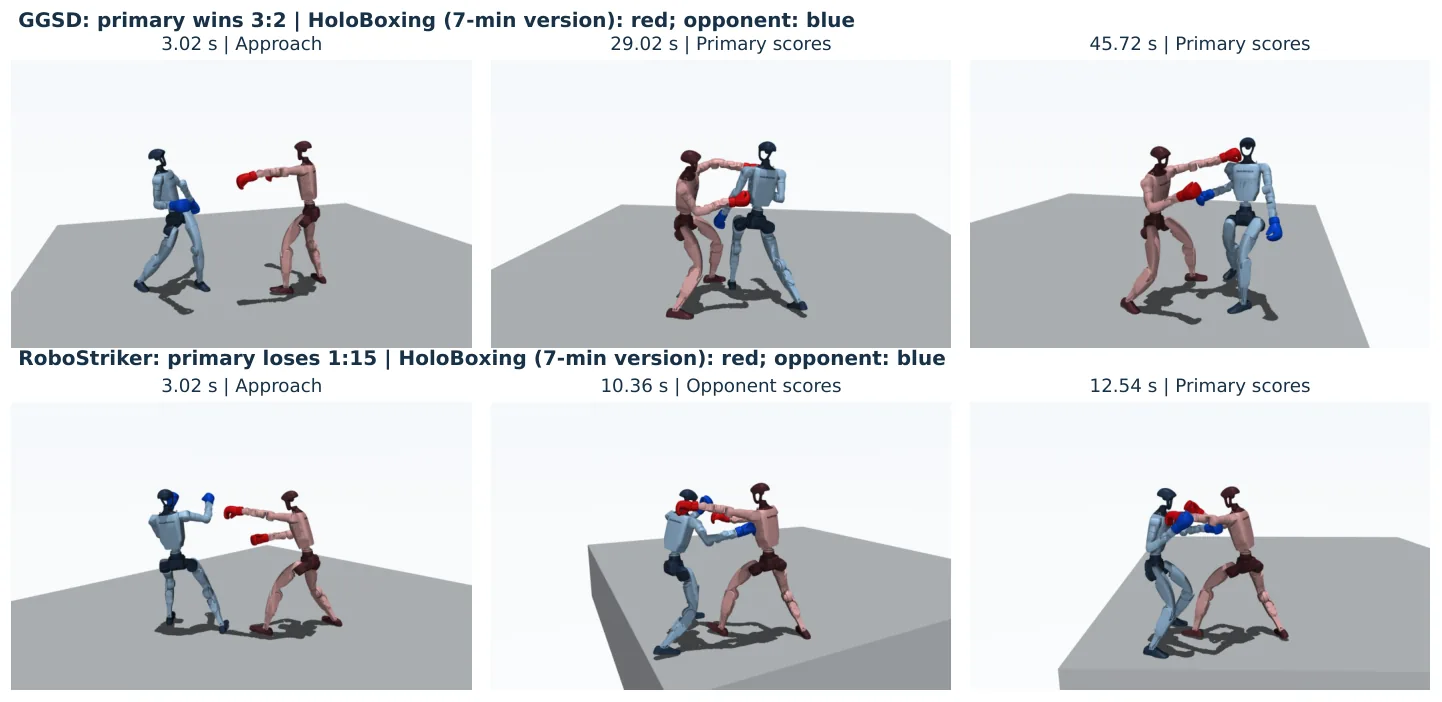
Figure E.1 is also simulation evidence, not physical-fight footage. The authors reconstructed its frames from saved poses for the seven-minute version, without running policy inference or physics stepping. The top sequence records a simulated win against GGSD and the bottom a simulated loss against RoboStriker; hit labels follow recorded referee events. Camera and lighting were adjusted, and some arena surfaces were hidden for visibility. These examples illustrate the reported simulated bouts but provide no evidence of real-world transfer or a physical robot match.